
You’ve set up your tank, added your fish, and watched everything settle in. Then one morning, you notice your angelfish acting sluggish or your coral closing up tighter than usual. Your first instinct might be to reach for a medication, but more often than not, the real culprit is hiding in the water chemistry. Without a reliable way to measure what’s happening on a molecular level, you’re essentially flying blind. Choosing the right aquarium water testing kit isn’t just about buying the first box you see at the pet store—it’s about matching the tool to the specific demands of your tank so you can catch small problems before they become fatal ones.
Key Takeaways
- Your tank type dictates your testing needs: freshwater tanks require ammonia, nitrite, nitrate, and pH, while reef tanks demand calcium, alkalinity, and magnesium monitoring.
- Liquid drop kits are generally more accurate than test strips, but strips offer unmatched speed and convenience for quick weekly checks.
- Look for kits that include clear instructions, color charts with true-to-life representations, and a reasonable number of tests (at least 100) for long-term value.
- Learn how to verify your kit’s accuracy by testing a known water sample or comparing results with a second method before you trust a critical reading.
Why Accurate Water Testing Matters More Than You Think
Fish and invertebrates are incredibly sensitive to chemical fluctuations. In the wild, they live in vast bodies of water where toxins are quickly diluted. In an aquarium, waste products like ammonia and nitrite can accumulate rapidly—sometimes reaching lethal concentrations within hours. A dependable testing routine helps you understand your tank’s biological cycle, determine safe stocking levels, and respond quickly to emergencies like equipment failure overfeeding, or unexpected die-offs.
The challenge is that not all testing kits are created equal. Some are precise enough for advanced reef keeping, while others are only suitable for basic freshwater maintenance. Understanding what you’re looking at—and what you actually need—is the difference between confident aquarium keeping and guessing your way through avoidable crises.
Understand Your Tank’s Specific Testing Demands
Before you can evaluate any product, you need to know exactly which parameters your aquarium demands. Testing for everything under the sun is wasteful; missing one critical parameter is risky. Here’s a quick breakdown of what different setups require.
Freshwater Community Tanks
If you keep a standard freshwater tank with community fish like tetras, guppies, or corydoras, you need to monitor the nitrogen cycle constantly. The essentials include ammonia (NH3/NH4+), nitrite (NO2-), and nitrate (NO3-). pH is also important because sudden swings cause stress, but you generally won’t need to test phosphate unless you’re struggling with algae outbreaks. For most beginners, a kit covering these four baseline parameters is enough to start a new tank and keep fish healthy.
Planted Aquariums
Aquascapers with live plants need to pay attention to additional parameters that affect photosynthesis and nutrient uptake. Beyond the nitrogen cycle, you’ll want to monitor phosphate, potassium, and iron. Many planted tank hobbyists also monitor carbonate hardness (KH) because it directly impacts CO2 injection stability. If you run a pressurized CO2 system, daily pH testing is necessary to maintain the correct concentration without gassing your fish.
Saltwater and Reef Tanks
Marine tanks demand a significantly more rigorous testing schedule. In addition to pH and the nitrogen cycle compounds, you need to monitor salinity (specific gravity), alkalinity (dKH), calcium, and magnesium. These three major elements need to stay within precise ranges for corals to grow and for invertebrates to maintain their exoskeletons. In mature reef tanks, many aquarists test alkalinity daily or even twice daily, because it fluctuates quickly and has a direct impact on coral health.
Specialty or Sensitive Species
Some species have strict requirements that go beyond standard testing. Discus require soft, acidic water, African cichlids need high pH with high mineral content, and shrimp species like Crystal Reds need extremely stable parameters with virtually zero copper. If you keep any of these specialized creatures, research their exact water requirements before you choose a kit to ensure it covers all the tests they need.
Test Strips vs. Liquid Test Kits: Which Should You Choose?
This is the most fundamental choice you’ll make when selecting a testing method. Both approaches measure the same chemical parameters, but they operate very differently. Each has distinct pros and cons that matter depending on how much precision you need and how much time you are willing to spend testing.
Test Strips
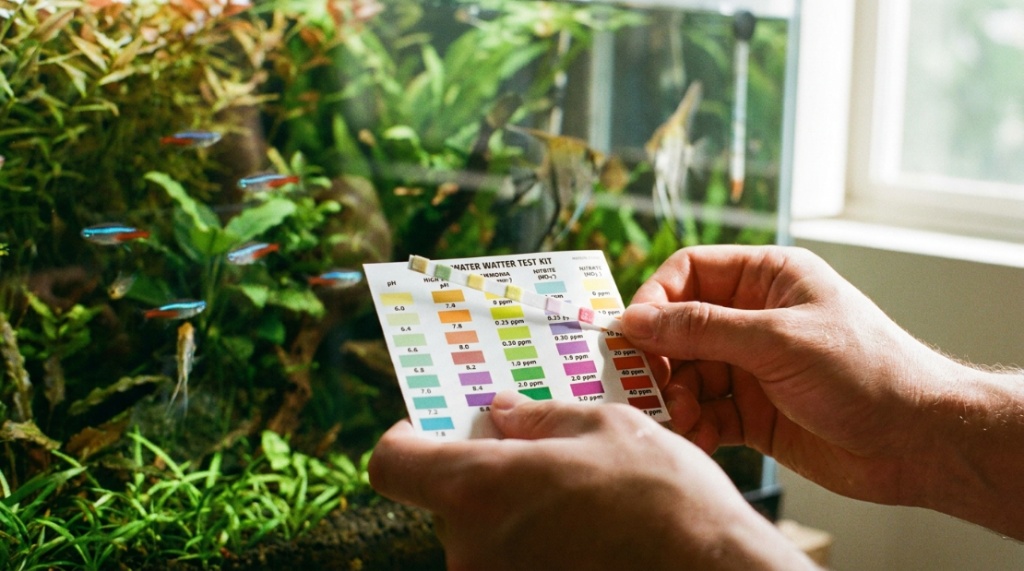
Test strips are simply thin plastic strips with reactive pads embedded at one end. You dip the strip into the tank water (or into a clean water sample), swish it around, wait a specific number of seconds, and compare the color change to a chart on the bottle.
The biggest advantage here is speed. You can test five or more parameters in under two minutes, making strips an excellent option for busy hobbyists who need a general health snapshot without spending half an hour hunched over test tubes. Some modern strips also offer enhanced resolution for parameters like pH, making them easier to read accurately.
However, the trade-off is accuracy. Strips are notoriously difficult to read because the color changes on the pads can be subtle, especially in the mid-ranges of a parameter like nitrate. Factors like lighting, color perception, and even slight variations in dip time can cause misreadings. For those reasons, aquarium test strips work best for routine monitoring between more comprehensive liquid tests.
Liquid Drop Kits
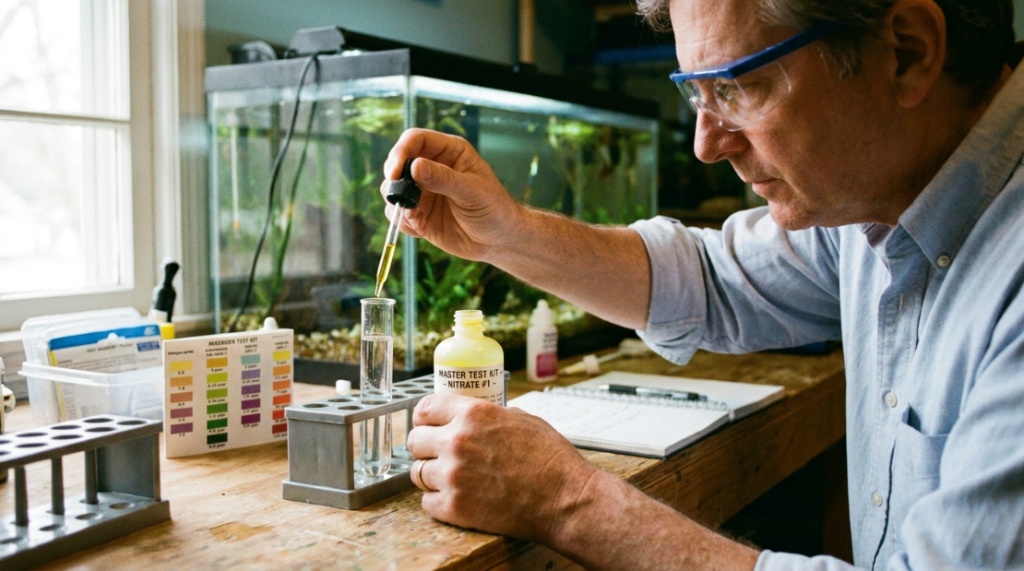
Liquid drop kits are the gold standard for accuracy in the aquarium hobby. You draw a small water sample into a glass tube, add a specific number of reagent drops, and compare the resulting color to a provided chart. Some tests, like alkalinity titration tests, involve adding drops one at a time until a color change occurs, which gives you a very precise numerical value.
Liquid kits produce more reliable, reproducible results because the color reactions are generally more distinct, and the test surface is clear glass rather than opaque white paper. But they take longer, and you need to clean and rinse your test tubes between uses to avoid contamination.
If you are maintaining a reef aquarium or caring for high-value sensitive fish, a liquid drop kit is not just recommended—it’s essential. The cost is slightly higher upfront, but the accuracy is well worth the premium.
If you’re looking for a comprehensive option that covers multiple important parameters in one package, consider the aquarium water testing kit options available from trusted suppliers. They often bundle premium test strips with detailed reference guides, making it easy to track your results over time.
Evaluate Readability and Ease of Use
Even the most accurate test kit in the world is useless if you can’t read it or if the instructions are unclear. Misinterpreting a color chart is one of the most common sources of hobbyist error. For example, a pH reading that looks like 7.6 to one person may look like 7.8 to another. Your ability to distinguish subtle color differences matters hugely.
When evaluating a kit, consider the clarity of the color chart. Some brands print their charts on cardboard with glossy finishes that reflect light, making comparisons difficult. Others use laminated cards with matte surfaces that are much easier to read under natural daylight. Test tube size matters too: clear flat-bottomed glass tubes with wide diameters are easier to read than thin, curved plastic tubes that cause light distortion.
For people with red-green color blindness, it is generally a good idea to use digital testers or kits that rely on titration endpoints (color changes from one distinct shade to another) rather than continuous color gradient charts.
Consider Digital Testing and Automated Monitors
The aquarium industry has moved toward digital solutions that reduce human error. Handheld digital testers exist for specific parameters like pH, ORP, and total dissolved solids. For reef keepers, benchtop or probe-based controllers like the Hanna Checkers or Neptune Systems Trident can provide continuous monitoring and automatic logging of alkalinity, calcium, and magnesium.
Digital testers read water in real time and display quantitative results on a screen, removing any guesswork about color matching. The downside is the initial expense and ongoing calibration costs. You’ll need to buy calibration solution regularly to keep the sensors accurate. For many hobbyists, a hybrid routine is ideal: use digital monitors for the most volatile parameters (like pH) and liquid drop kits for less frequent comprehensive checks of the nitrogen cycle. To prepare the right environment for specific species, read our guide on how to make brackish water for aquarium.
The Right Number of Tests
Each kit you buy has a finite number of tests. Pay attention to this before you purchase, because some bargain kits cost less upfront but deliver only a handful of tests. If you buy a budget ammonia liquid kit that contains 20 tests, you will need four of those kits to get through a single month of daily testing during a new tank cycle. That makes the budget option far more expensive in the long run.
Good-value liquid kits typically contain up to 50 tests per parameter. Test strips typically come in bottles of 25 to 100 strips. When comparing the cost per test, remember to factor in the number of parameters you intend to test simultaneously. If you test ammonia, nitrite, and nitrate three times a week, you will replace that kit much faster than a hobbyist who tests only once a week.
Checking Kit Accuracy
All kits eventually expire. Reagents lose potency over time, and an expired kit provides dangerously inaccurate readings without any visible signs of failure. Always check the expiration date on the box before buying, and write the date of first use on the bottle so you can track how long you have relied on it—most reagents remain effective for about 18 months after opening if stored in a cool, dark place.
If you want to verify your kit’s accuracy, purchase a calibration standard. You can buy known concentration samples for parameters like pH and ammonia from aquarium suppliers, or you can make a simple test using bottled distilled water so you know what the result should be. If you run a titration test on your freshly made saltwater and get a reading wildly different from the expected alkalinity, there’s a strong chance your kit is old or contaminated.
Frequently Asked Questions
How often should you test your aquarium water?
For a new tank under cycling, test ammonia and nitrite every day. For an established tank, test once a week for baseline monitoring. If you notice signs of distress in your fish or algae growth, test daily until you diagnose the issue. High-demand reef tanks may require daily testing of alkalinity and calcium.
What is the most important water parameter to test?
Ammonia is the most critical for freshwater tanks because even low levels are highly toxic to fish. For saltwater reefs, alkalinity is the most critical because it stabilizes pH and directly impacts coral calcification.
Can you use aquarium test strips for saltwater tanks?
Yes, but only if they are designed specifically for saltwater. Freshwater strips do not measure salinity, calcium, or alkalinity at the appropriate ranges. Saltwater-specific strips are fine for quick checks, but you should also own liquid drop kits for calcium and alkalinity for precise control in a reef system.
Are API test kits reliable?
API makes some of the most widely used liquid test kits in the world. Their ammonia, nitrite, and nitrate tests are consistently reliable for freshwater use. The API Reef Master Kit is also considered a solid option by many beginning reef keepers, although advanced aquarists sometimes prefer higher-resolution testers for alkalinity.
What happens if I don’t test my aquarium water?
You risk leaving dangerous conditions undetected. Ammonia spikes and pH crashes can kill livestock quickly, while slow-building nitrate accumulation can stress fish and cause long-term health problems like weakened immune systems and low appetite. Regular testing is the best prevention.
Conclusion
The right aquarium water testing kit comes down to knowing what you keep, how much precision you require, and how much time you want to spend on maintenance. For most freshwater hobbyists, reliable liquid drop kits covering ammonia, nitrite, nitrate, and pH will serve you well. Marine keepers need to expand into alkalinity, calcium, and magnesium, and digital monitors are worth considering if your budget allows. Choose a kit that you will actually use consistently—because the most expensive testing system is the one that goes unused while your fish suffer from an undetected problem. Read charts carefully, track your results over time, and remember that testing is not just a routine; it is your best tool for giving your aquarium the stable environment its inhabitants deserve.


